


TFT LCD Module and TFT Modules: A Complete Guide to Features, Applications, Selection, and Performance
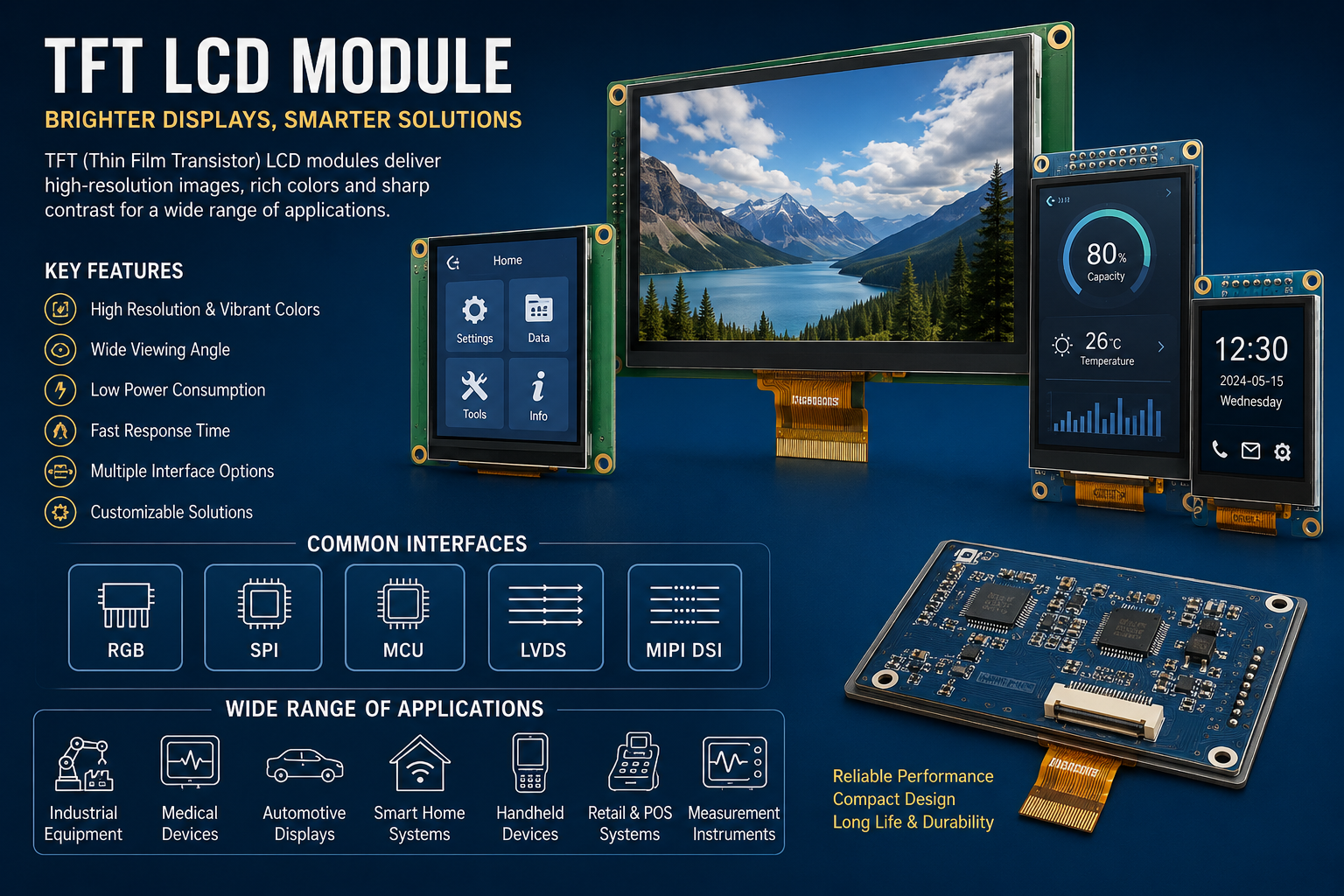
Display technology plays a major role in modern electronics, from industrial control panels and medical equipment to smart appliances, automotive systems and handheld devices. Among the many display technologies available today, the TFT LCD Module has become a widely used solution because it combines clear image quality, responsive performance, compact construction and flexible integration.
A well-selected TFT Modules solution can improve both the visual experience and usability of an electronic product. However, choosing the right display requires more than simply considering screen size. Resolution, interface, brightness, viewing angle, touch functionality, operating conditions and power requirements all influence final performance.
This guide explains how TFT display technology works, its major benefits, applications and important selection factors.
What Is a TFT LCD Module?
A TFT LCD Module is a liquid crystal display that uses Thin-Film Transistor technology to control individual pixels. Each pixel is associated with tiny transistors that regulate the amount of light passing through the liquid crystal layer.
Compared with simpler LCD technologies, TFT provides better control over individual pixels. This results in improved image sharpness, colour reproduction and response speed.
A complete module may include several components, such as:
-
TFT LCD panel
-
Backlight system
-
Driver integrated circuits
-
Flexible printed circuit connection
-
Controller circuitry
-
Protective glass
-
Optional touch panel
Because many important display components are integrated together, TFT Modules can simplify the development of electronic products.
How TFT LCD Technology Works
The basic principle behind a TFT LCD Module involves controlling light rather than generating it directly from every pixel.
A backlight produces illumination behind the LCD panel. Liquid crystal material controls how this light passes through individual pixels. Thin-film transistors manage the electrical signal delivered to each pixel, allowing accurate control of brightness and colour.
Colour TFT displays generally use red, green and blue sub-pixels. By changing the intensity of these sub-pixels, the display can reproduce a broad range of colours.
This active-matrix structure is one of the main reasons TFT Modules can provide detailed graphics, smoother visual transitions and better responsiveness.
Key Benefits of TFT LCD Modules
Modern electronics manufacturers often choose TFT technology because it provides a useful balance between performance, cost and design flexibility.
Important advantages include:
-
Sharp visual quality – High pixel density supports detailed graphics, icons and text.
-
Good colour reproduction – TFT displays are suitable for interfaces where colour information matters.
-
Fast response – Active pixel control supports responsive graphical interfaces.
-
Multiple size options – Modules are available for compact portable equipment as well as larger control systems.
-
Touchscreen compatibility – Capacitive and resistive touch technologies can be integrated.
-
Flexible interfaces – Different interface options support various processors and system architectures.
-
Compact construction – Thin display designs are useful in space-sensitive electronic products.
-
Broad application range – TFT technology works across consumer, industrial, commercial and specialized equipment.
TFT LCD Module vs Traditional LCD Display
| Feature | TFT LCD Module | Traditional LCD |
|---|---|---|
| Pixel Control | Individual active control | More basic pixel control |
| Colour Quality | Higher | Generally limited |
| Response Speed | Faster | Usually slower |
| Graphics | Detailed and dynamic | Better for basic information |
| Touch Integration | Widely supported | Depends on design |
| User Interface | Suitable for advanced GUI | Suitable for simpler interfaces |
| Applications | Industrial, automotive, medical, smart devices | Calculators, meters, basic electronics |
The best choice depends on the intended product. A simple device showing numbers may not need advanced TFT technology. A graphical control system, however, can benefit considerably from a TFT LCD Module.
Important Specifications When Choosing TFT Modules
Selecting TFT Modules should begin with the actual operating requirements rather than appearance alone.
Screen size determines how much physical space the display occupies, while resolution affects the amount of information and graphical detail visible on the screen.
Brightness is especially important for equipment used in environments with strong ambient lighting. Displays installed outdoors or close to windows may require higher brightness than displays used indoors.
Viewing angle should also be evaluated. If operators need to see the screen from different positions, wider viewing angles can improve usability.
Other important specifications include:
-
Display resolution
-
Active viewing area
-
Contrast ratio
-
Backlight brightness
-
Operating temperature
-
Storage temperature
-
Response time
-
Colour depth
-
Interface type
-
Touch technology
-
Power consumption
-
Mechanical dimensions
Evaluating these specifications together helps engineers avoid choosing a display that looks suitable on paper but performs poorly in the final environment.
Common Interfaces Used in TFT Modules
The communication interface determines how a processor communicates with the display.
Common options may include RGB, LVDS, MIPI, SPI and MCU interfaces. Each interface serves different product requirements.
SPI can be useful in smaller systems where fewer connection pins are preferred. RGB interfaces can support direct pixel communication in embedded applications. LVDS is commonly considered when higher-speed data transmission is required, while MIPI interfaces can support compact, high-performance electronic designs.
The correct interface should match both the processor and the performance requirements of the TFT LCD Module.
Touchscreen Options for TFT Displays
Touch capability can transform a conventional display into an interactive human-machine interface.
Capacitive touchscreens are commonly used where smooth gesture control and modern user interaction are priorities. They can support actions such as tapping, swiping and multi-touch operation.
Resistive touchscreens respond to physical pressure and can be useful in applications where operators may wear gloves or use a stylus.
Choosing between these technologies should be based on operating conditions, user behaviour and required interface functionality.
Applications of TFT LCD Modules
The versatility of TFT Modules makes them suitable for numerous electronic products.
Common applications include:
-
Industrial automation panels
-
Human-machine interfaces
-
Medical monitoring equipment
-
Diagnostic instruments
-
Smart home appliances
-
Security systems
-
Automotive dashboards
-
Navigation systems
-
EV charging equipment
-
Handheld instruments
-
Point-of-sale equipment
-
Test and measurement devices
-
Communication equipment
-
IoT control systems
Industrial products may prioritize durability and temperature tolerance, while consumer devices may place greater emphasis on slim design and visual appearance.
How to Choose the Right TFT LCD Module
A structured selection process can reduce development problems.
First, determine the required screen dimensions and resolution. Next, identify the expected environment, including temperature, lighting and viewing conditions.
Then evaluate processor compatibility and determine which display interface is most appropriate.
Consider whether touch control is required and, if so, whether capacitive or resistive technology better suits the users.
Finally, review mechanical integration, backlight performance, expected product lifecycle and overall power consumption before selecting the final TFT LCD Module.
Factors That Influence Display Performance
Display performance depends on more than resolution.
Backlight quality influences brightness uniformity. Contrast affects the distinction between dark and bright areas. Viewing-angle characteristics determine how well information remains visible when the display is viewed from different positions.
Environmental conditions can also have a major impact. Excessive heat, cold, humidity, vibration or strong sunlight may affect performance if the display has not been selected for those conditions.
For this reason, engineers should evaluate the TFT Modules as part of the complete device rather than as an isolated component.
Future of TFT Display Technology
TFT display technology continues to evolve alongside connected devices, industrial automation, smart transportation and advanced human-machine interfaces.
Future development is likely to focus on improved brightness, lower power consumption, thinner construction, stronger touch integration and greater durability.
Although alternative display technologies are available, the TFT LCD Module remains relevant because of its combination of performance, availability, design flexibility and suitability for many electronic applications.
Frequently Asked Questions About TFT LCD Module and TFT Modules
1. What does TFT stand for?
TFT stands for Thin-Film Transistor, a technology used for controlling individual pixels in an LCD.
2. What is a TFT LCD Module used for?
A TFT LCD Module is used for displaying text, graphics, images and interactive interfaces in electronic equipment.
3. Are TFT Modules suitable for industrial equipment?
Yes. Appropriate industrial-grade TFT Modules can be used in automation systems, control panels, instruments and machinery.
4. Can a TFT display include touchscreen functionality?
Yes. TFT displays can be integrated with capacitive or resistive touch panels.
5. What determines TFT display quality?
Resolution, brightness, contrast, viewing angle, backlight quality, colour performance and controller design all affect display quality.
6. Which interface is best for TFT LCD displays?
There is no single best interface. The right option depends on the processor, data speed, display resolution and overall system design.
7. Can TFT displays be used outdoors?
Yes, provided the selected display offers appropriate brightness, temperature tolerance and environmental protection.
8. Does higher resolution always mean a better display?
Not necessarily. Resolution should be balanced with screen size, processing capability, power consumption and viewing distance.
9. Are TFT LCD Modules energy efficient?
They can provide efficient performance, although total power consumption depends heavily on screen size, brightness and backlight operation.
10. What should engineers check before selecting TFT Modules?
They should evaluate size, resolution, brightness, interface, touch requirements, viewing angle, environmental conditions, mechanical dimensions and power requirements.
- Technology for Students
- Admissions & Applications
- Online Courses
- Career and Jobs
- Campus Life
- Drinks
- Film
- Fitness
- Food
- Jocuri
- Gardening
- Health
- Home
- Literature
- Music
- Networking For Students
- Insights
- Party
- Religion
- Shopping
- Sports
- Theater
- Wellness
- Education News
- Business & Finance For Students
- Security, Law & Crime Education
- Insurance
- Science & Technology For Students
 Romaian
 English
 Arabic
 French
 Spanish
 Portuguese
 Deutsch
 Turkish
 Dutch
Dutch
 Italiano
 Russian
 Portuguese (Brazil)
 Greek
Greek