


Silicone Compression Molding and Low Volume Silicone Molding for Flexible Production
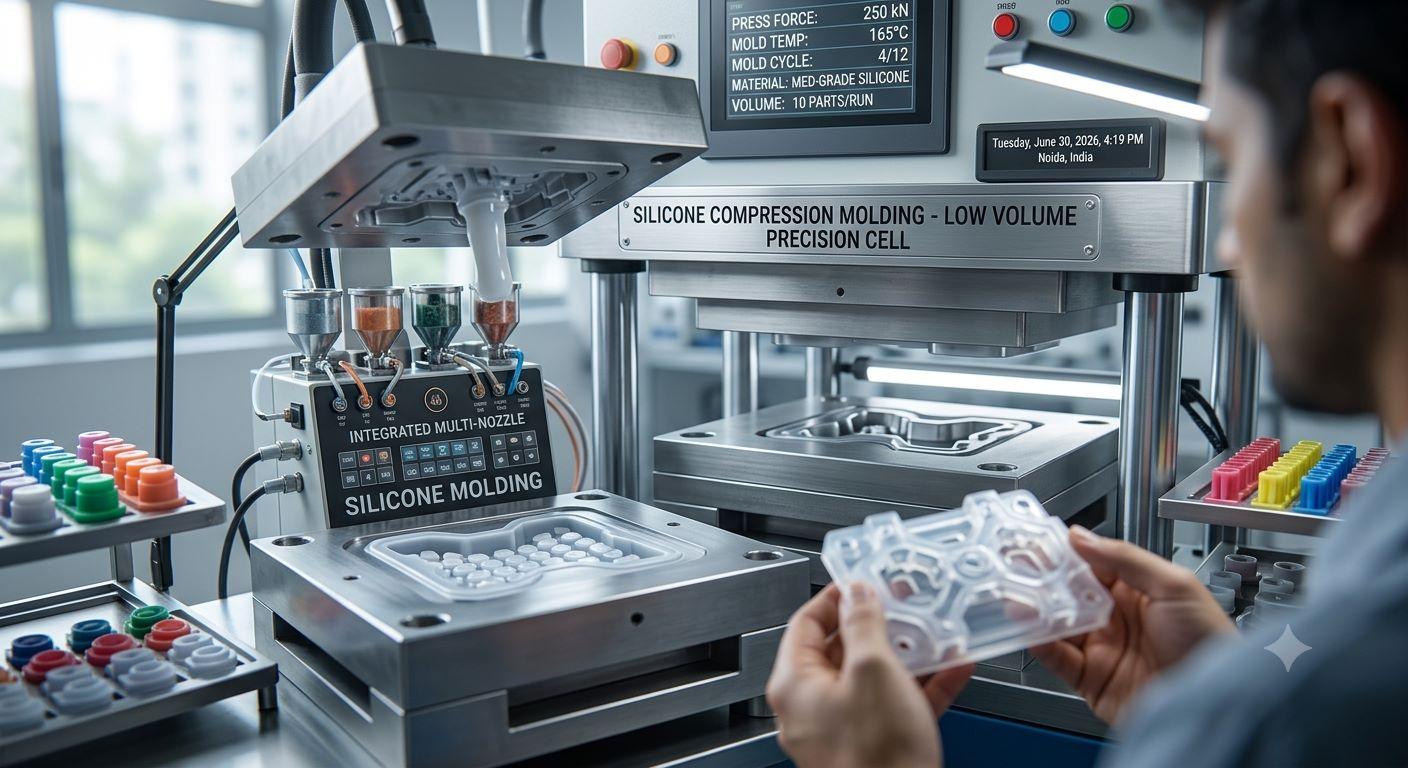
Modern product development often requires flexible manufacturing methods that can deliver accurate silicone parts without forcing companies into large production commitments. Silicone compression molding and low volume silicone molding provide practical solutions for prototypes, specialty components, testing programs, and limited production runs.
These processes are widely considered when manufacturers need durable, flexible, heat-resistant, and application-specific silicone components. From seals and gaskets to protective covers and custom industrial parts, silicone molding can support complex product requirements while maintaining design flexibility.
Choosing the right molding method depends on part geometry, material characteristics, production volume, tooling requirements, tolerances, and end-use conditions. Understanding how both approaches work helps manufacturers make better decisions during development and production.
What Is Silicone Compression Molding?
Silicone compression molding is a manufacturing process in which a measured amount of silicone material is placed into an open heated mold cavity. The mold is then closed under pressure, forcing the material to spread and conform to the required shape.
Heat and pressure allow the silicone to cure inside the mold. Once curing is complete, the mold opens and the finished component is removed.
This method is commonly used for:
-
Gaskets
-
Seals
-
Protective pads
-
Keypads
-
Electrical components
-
Medical device components
-
Industrial covers
-
Flexible connectors
-
Custom rubber parts
The process can accommodate different silicone formulations depending on performance requirements.
How Silicone Compression Molding Works
A typical silicone compression molding cycle follows several controlled stages.
Material Preparation
The silicone compound is prepared according to the required formulation, hardness, color, and performance characteristics.
Material Placement
A carefully measured amount of silicone is positioned inside the mold cavity.
Compression and Heating
The mold closes and applies pressure while heat activates the curing process.
Final Curing and Removal
After sufficient curing, the component is removed, inspected, and trimmed if excess material is present.
Accurate control of pressure, temperature, material quantity, and curing time is important for maintaining consistent part quality.
What Is Low Volume Silicone Molding?
Low volume silicone molding refers to producing silicone components in relatively small quantities instead of committing immediately to high-volume manufacturing.
It is particularly useful during prototype development, market testing, product improvement, customized production, bridge manufacturing, and specialized industrial programs.
Manufacturers can use low-volume production to evaluate real components before scaling a product to larger quantities.
Why Low Volume Silicone Molding Is Important
Traditional high-volume manufacturing may require significant tooling investment and production commitments. Smaller production programs provide greater flexibility.
Companies can use low volume silicone molding to:
-
Validate product geometry.
-
Test silicone materials.
-
Check assembly performance.
-
Produce samples for customer evaluation.
-
Support engineering trials.
-
Manufacture replacement parts.
-
Introduce products gradually.
-
Modify designs before scaling production.
This approach can reduce development risk because manufacturers are not forced to produce large quantities before a design has been fully evaluated.
Silicone Compression Molding vs Low Volume Silicone Molding
Although these terms are closely related, they describe different aspects of manufacturing.
| Factor | Silicone Compression Molding | Low Volume Silicone Molding |
|---|---|---|
| Main Meaning | Specific molding process | Production quantity strategy |
| Production Volume | Small to large runs | Primarily smaller batches |
| Tooling | Compression mold required | Tooling depends on process |
| Flexibility | Good for many silicone parts | High design flexibility |
| Development Use | Prototype and production | Prototypes and bridge production |
| Best For | Molded silicone components | Limited or evolving demand |
In many cases, silicone compression molding can itself be used as a method for low volume silicone molding.
Major Benefits of Silicone Compression Molding
This manufacturing approach offers several practical benefits.
Flexible Part Design
Compression molds can produce a wide variety of shapes, thicknesses, surface features, and functional details.
Material Performance
Silicone materials can offer flexibility, temperature resistance, electrical insulation, chemical resistance, and durability depending on the formulation selected.
Suitable for Different Production Quantities
The process can support prototype quantities as well as ongoing production when properly planned.
Reduced Material Complexity
Compression molding uses a relatively direct molding approach, which can make it suitable for parts that do not require extremely complex automated injection systems.
Benefits of Low Volume Silicone Production
The greatest advantage of low volume silicone molding is manufacturing flexibility.
It allows businesses to produce exactly what is needed during early or specialized stages of a project.
Key advantages include:
-
Lower initial production commitment
-
Faster design iteration
-
Easier engineering changes
-
Practical functional testing
-
Reduced inventory exposure
-
Better market validation
-
Support for customized products
-
Efficient bridge production
This makes low-volume manufacturing particularly useful for startups, engineering teams, specialized equipment manufacturers, and companies introducing new products.
Design Considerations for Silicone Molded Parts
Successful silicone molding begins with good product design.
Manufacturers should carefully consider:
-
Wall thickness
-
Parting line location
-
Draft requirements
-
Undercuts
-
Surface finish
-
Hole geometry
-
Flash tolerance
-
Material hardness
-
Compression behavior
-
Final operating environment
Designing parts specifically for manufacturability can reduce production challenges and improve consistency.
Quality Control in Silicone Molding
Quality should be monitored throughout the molding process rather than only after production.
Important checks may include dimensions, appearance, hardness, surface condition, flash, color consistency, and functional performance.
The inspection method should reflect how the component will actually be used.
For example, a sealing component may require evaluation of dimensional fit and compression characteristics, while an electrical component may need additional functional testing.
Applications Across Different Industries
Both silicone compression molding and low volume silicone molding can serve diverse industries.
Common applications include:
-
Automotive systems
-
Electronics
-
Industrial machinery
-
Medical equipment
-
Consumer products
-
Energy systems
-
Laboratory devices
-
Food-processing equipment
-
Telecommunications
-
Specialized engineering products
Silicone is particularly valuable where flexibility, sealing performance, insulation, or temperature resistance is important.
Sustainability and Manufacturing Efficiency
Manufacturers are increasingly looking for ways to improve material efficiency and production planning.
Accurate material measurement can help reduce excess flash and waste. Efficient mold layouts can improve production output, while careful process control can reduce rejected parts.
Low-volume production can also reduce unnecessary inventory because components are produced closer to actual demand.
Sustainability ultimately depends on material selection, energy use, tooling life, production efficiency, waste management, and the expected service life of the finished product.
Future of Silicone Molding Technology
Silicone manufacturing continues to evolve through improved mold design, better process monitoring, automation, digital simulation, advanced materials, and more accurate inspection systems.
Digital design tools can help engineers identify manufacturing issues before tooling is created. Automated process control can also improve repeatability.
Future manufacturing strategies will likely combine flexible tooling, intelligent equipment, improved material science, and data-driven production management.
Frequently Asked Questions
1. What is silicone compression molding?
Silicone compression molding uses heat and pressure to shape silicone material inside a mold cavity.
2. What is low volume silicone molding?
It is the production of relatively small quantities of silicone components for prototypes, customized products, testing, or limited production.
3. Is compression molding suitable for prototypes?
Yes. Compression molding can be used for functional prototypes when appropriate tooling and materials are available.
4. What products can be made from molded silicone?
Common products include seals, gaskets, pads, covers, keypads, flexible connectors, and protective components.
5. Why choose low-volume production?
It allows manufacturers to test designs and market demand before committing to larger production quantities.
6. Can silicone parts resist high temperatures?
Many silicone formulations offer good temperature resistance, although performance depends on the specific material grade.
7. Is silicone molding suitable for complex shapes?
Yes, although manufacturability depends on geometry, mold design, undercuts, tolerances, and other design factors.
8. What affects the quality of compression-molded silicone?
Material preparation, temperature, pressure, curing time, mold design, and process control can all influence quality.
9. Can silicone molding support customized components?
Yes. Low volume silicone molding is particularly useful for custom and application-specific components.
10. How do manufacturers choose the right silicone material?
Selection usually depends on hardness, flexibility, temperature exposure, chemical environment, color, electrical requirements, and intended use.
- Technology for Students
- Admissions & Applications
- Online Courses
- Career and Jobs
- Campus Life
- Drinks
- Film
- Fitness
- Food
- Jocuri
- Gardening
- Health
- Home
- Literature
- Music
- Networking For Students
- Insights
- Party
- Religion
- Shopping
- Sports
- Theater
- Wellness
- Education News
- Business & Finance For Students
- Security, Law & Crime Education
- Insurance
- Science & Technology For Students
 Romaian
 English
 Arabic
 French
 Spanish
 Portuguese
 Deutsch
 Turkish
 Dutch
Dutch
 Italiano
 Russian
 Portuguese (Brazil)
 Greek
Greek