


Active RFID Tags and RFID Access Control: Smart Security for Modern Facilities
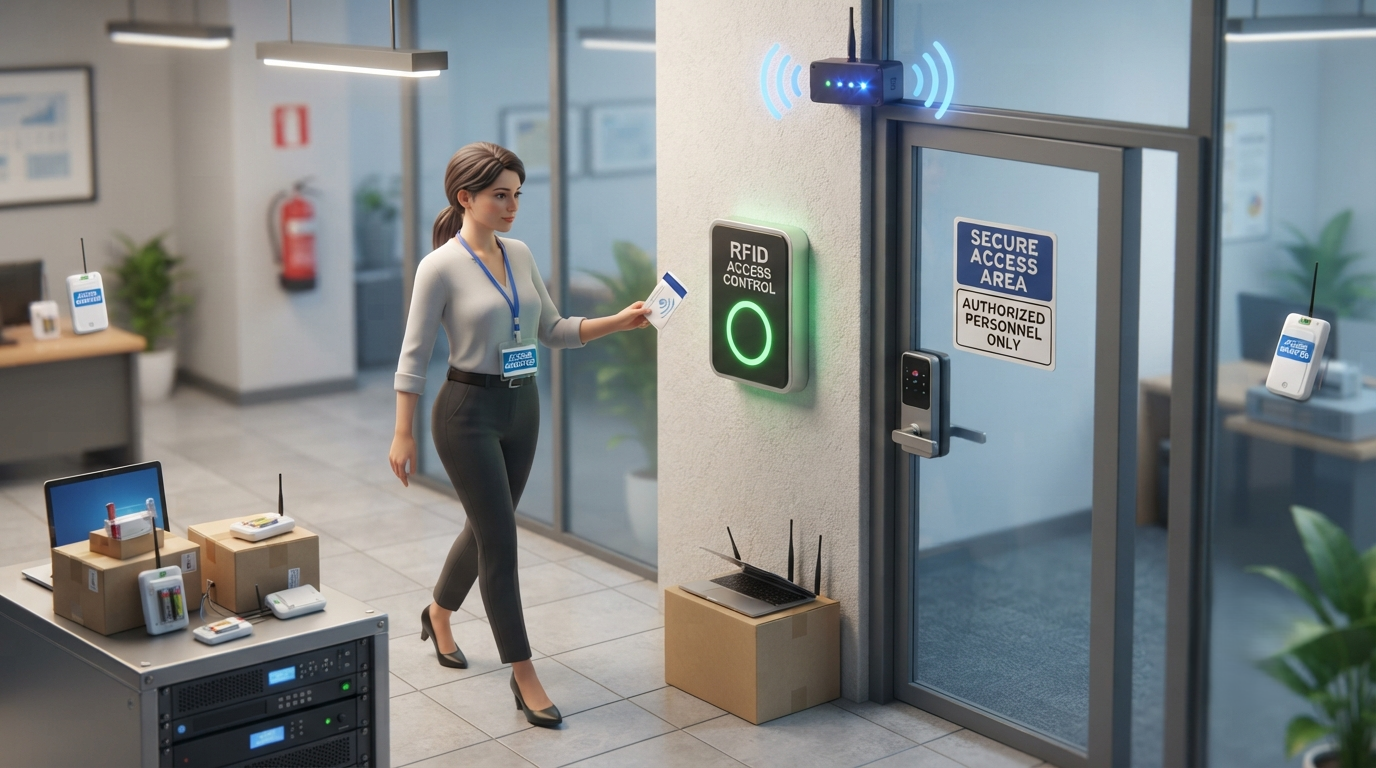
As workplaces, warehouses, hospitals, factories, campuses, and logistics facilities become increasingly connected, RFID technology is playing a larger role in intelligent security and identification.
Two technologies attracting significant attention are Active RFID Tags and RFID Access Control. Although both rely on radio frequency identification, they serve different purposes. Active RFID helps organizations locate and monitor valuable assets or people over greater distances, while RFID-based access control manages who can enter specific locations.
When combined strategically, these technologies can create a connected security ecosystem that improves visibility, automation, operational efficiency, and accountability.
What Are Active RFID Tags?
Active RFID Tags are electronic identification devices equipped with their own internal power source, usually a battery. Unlike passive RFID tags, which receive energy from an RFID reader, active tags can continuously or periodically transmit signals.
Because they generate their own signals, active RFID devices can usually communicate over greater distances and support real-time or near-real-time tracking applications.
An active RFID system generally includes:
-
RFID tags attached to assets, equipment, vehicles, or identification badges
-
RFID readers or receivers
-
Antennas and gateways
-
Tracking or monitoring software
-
Databases and management dashboards
Each tag contains a unique identifier that allows the system to recognize and monitor the tagged object.
How Active RFID Tags Work
When an active RFID tag comes within the coverage area of an RFID infrastructure, it transmits identification data to nearby readers. The reader forwards this information to software that records and processes the signal.
The typical process includes:
-
A powered RFID tag broadcasts its unique information.
-
RFID readers detect the transmitted signal.
-
Reader data is transferred to a central platform.
-
Software identifies the associated person, asset, or vehicle.
-
Location, movement, or status information is displayed for authorized users.
This continuous communication makes Active RFID Tags valuable where organizations need greater visibility across large operational environments.
What Is RFID Access Control?
RFID Access Control is a security system that uses RFID credentials to identify individuals and determine whether they are authorized to enter a particular area.
Instead of using conventional keys, authorized users may carry an RFID card, badge, key fob, or compatible credential.
When the credential approaches a reader, the system verifies its identification data against stored permissions. If authorization is confirmed, the door, gate, turnstile, or controlled entrance can be unlocked.
Modern access systems may also record:
-
User identity
-
Entry time
-
Exit time
-
Access location
-
Rejected access attempts
-
Permission changes
These records can help organizations maintain greater control and accountability.
Active RFID Tags vs RFID Access Control
Although they use related technology, their primary functions differ.
| Feature | Active RFID Tags | RFID Access Control |
|---|---|---|
| Main Purpose | Asset and personnel tracking | Entry and security management |
| Power Source | Internal battery | Depends on credential technology |
| Tracking Capability | Real-time or periodic | Mainly access-event based |
| Typical Range | Longer communication range | Usually short to moderate range |
| Common Uses | Warehouses, logistics, equipment tracking | Offices, factories, restricted areas |
| Data Generated | Location and movement information | Entry and authorization records |
| Automation Potential | High | High |
Organizations can use either technology independently or integrate both when tracking and physical security are equally important.
Benefits of Active RFID Tags
Businesses adopt Active RFID Tags because they can improve visibility across complex environments.
Major benefits include:
-
Real-time asset identification
-
Faster equipment location
-
Reduced manual searching
-
Improved inventory visibility
-
Better asset utilization
-
Automated movement monitoring
-
Stronger operational transparency
-
Improved workflow management
For example, employees in a large facility can locate tagged equipment without manually searching multiple rooms or storage areas.
Benefits of RFID Access Control
A properly designed RFID Access Control system can provide more flexibility than traditional mechanical locks.
Important advantages include:
-
Centralized access management
-
Fast user identification
-
Reduced dependence on physical keys
-
Detailed entry records
-
Flexible permission settings
-
Faster credential cancellation
-
Controlled access to sensitive locations
-
Easier integration with other security technologies
When an employee leaves an organization, administrators can disable the credential electronically rather than replacing physical locks.
Where These RFID Technologies Are Used
RFID systems have applications across many industries.
Manufacturing
Factories can track tools, machines, materials, and employee movement while controlling entry into production areas.
Warehousing and Logistics
Active tags can help monitor pallets, containers, equipment, and vehicles moving through warehouses and distribution facilities.
Healthcare
Hospitals may use RFID for equipment visibility while access systems help protect pharmacies, laboratories, data rooms, and other controlled areas.
Corporate Offices
RFID Access Control can manage employee entry into offices, server rooms, meeting facilities, and restricted departments.
Educational Campuses
RFID credentials may support controlled building access while tracking systems can help manage institutional assets.
How Active RFID and Access Control Can Work Together
Integrating tracking and access technologies can create a more intelligent security environment.
Consider a controlled equipment room. An RFID access system can determine whether an employee is permitted to enter, while Active RFID Tags attached to valuable equipment can monitor whether those assets move into or out of designated zones.
This approach provides two different layers of visibility:
Who accessed the location?
What asset moved within or outside the location?
Combining these records can help security and operations teams investigate events more effectively.
Important Considerations Before Implementation
RFID deployment should begin with clear operational requirements rather than simply selecting technology.
Organizations should evaluate:
-
Required reading distance
-
Facility size
-
Number of users or assets
-
Environmental conditions
-
Battery maintenance requirements
-
Software compatibility
-
Data security
-
Reader placement
-
Scalability
-
Integration requirements
Security policies are equally important. Authentication, access permissions, encryption where supported, system monitoring, and regular credential reviews should form part of the overall security strategy.
The Future of RFID Security and Tracking
RFID systems are gradually becoming more connected with IoT platforms, cloud-based management systems, analytics, automation tools, and intelligent building technologies.
Future solutions are likely to place greater emphasis on unified dashboards where organizations can monitor assets, access events, locations, alerts, and operational patterns from a centralized system.
The combination of Active RFID Tags and RFID Access Control can therefore become more than an identification solution. It can form part of a wider connected infrastructure for security, asset intelligence, and automated operations.
Frequently Asked Questions About Active RFID Tags and RFID Access Control
1. What is an active RFID tag?
An active RFID tag is a powered identification device that can transmit radio signals to compatible RFID readers for tracking and monitoring applications.
2. Do active RFID tags require batteries?
Yes. Active tags generally contain an internal battery that powers communication and supporting functions.
3. What is RFID access control?
RFID Access Control uses RFID-enabled credentials and readers to authenticate individuals before allowing entry into controlled areas.
4. Are active RFID tags different from passive RFID tags?
Yes. Active tags have their own power source, while passive tags typically receive operating energy from the RFID reader.
5. Can RFID access control replace traditional keys?
In many commercial facilities, RFID credentials can replace or reduce dependence on conventional mechanical keys.
6. Can active RFID track assets in real time?
Active RFID can support real-time or near-real-time location monitoring depending on system design, reader infrastructure, and software.
7. Where is RFID access control commonly used?
It is widely suitable for offices, factories, warehouses, educational institutions, healthcare facilities, laboratories, and restricted operational areas.
8. Can RFID systems integrate with other security systems?
Yes. Depending on the platform, RFID systems may integrate with CCTV, visitor management, alarms, attendance solutions, IoT platforms, and building management systems.
9. What should businesses consider before selecting RFID technology?
Important considerations include reading range, environment, scalability, security requirements, integration capability, tag type, maintenance, and total deployment needs.
10. Can active RFID and access control work together?
Yes. Integrating Active RFID Tags with RFID Access Control can provide both asset visibility and controlled physical access within the same security strategy.
- Technology for Students
- Admissions & Applications
- Online Courses
- Career and Jobs
- Campus Life
- Drinks
- Film
- Fitness
- Food
- Games
- Gardening
- Health
- Home
- Literature
- Music
- Networking For Students
- Insights
- Party
- Religion
- Shopping
- Sports
- Theater
- Wellness
- Education News
- Business & Finance For Students
- Security, Law & Crime Education
- Insurance
- Science & Technology For Students
 English
 Arabic
 French
 Spanish
 Portuguese
 Deutsch
 Turkish
 Dutch
Dutch
 Italiano
 Russian
 Romaian
 Portuguese (Brazil)
 Greek
Greek